
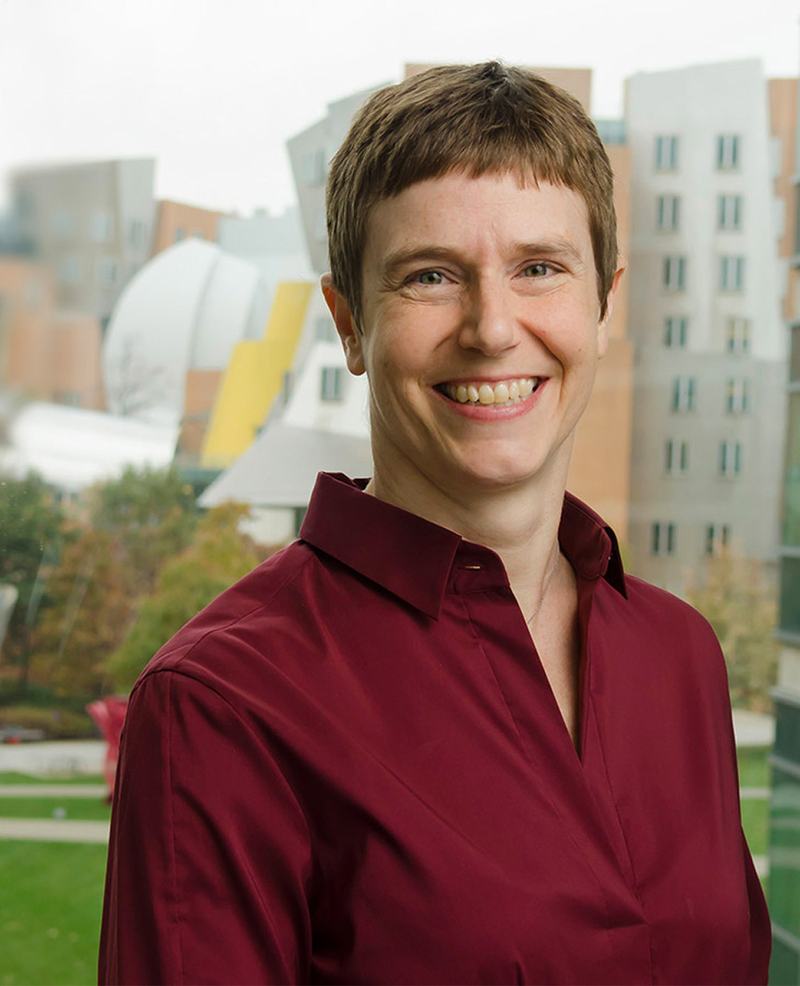
Jay A. Stein (1968) Professor of Biology, Professor of Biological Engineering, and Head of the Department of Biology
Massachusetts Institute of Technology, United States
Amy Keating studies how the interaction properties of proteins are encoded in their sequences and structures, and applies that understanding to design peptides and proteins with tailored binding specificity. Her laboratory integrates high-throughput binding assays, structural modeling, bioinformatics, and machine learning with biochemical and biophysical experiments, working deliberately on interactions simple enough to be understood in fine detail. Much of the group's work centers on α-helical coiled coils, the Bcl-2 family of apoptosis regulators, and modular domains that recognize short linear motifs.
That program has produced tools as well as insight. Early work on bZIP transcription factors mapped the sequence determinants of dimerization specificity and yielded SYNZIP, a set of native and designed heterospecific coiled-coil pairs now widely used in synthetic biology and nanoscale assembly. Structure- and data-driven models of BH3-motif binding have given tight-binding, selective peptide reagents for anti-apoptotic Bcl-2 family proteins, useful for profiling the apoptotic state of cancer cells. Recent projects extend the approach to TRAF, EVH1, and LC3B domains, to peptide inhibitors of toxin–antitoxin antiphage defense systems, and to the behavior of deep learning methods themselves, including how training bias and sequence alignments shape protein–peptide docking by AlphaFold.
Keating studied physics at Harvard and earned her PhD in organic chemistry at UCLA in 1998, working on carbene reaction mechanisms with Kendall Houk and Miguel García-Garibay. She came to protein biochemistry as a Helen Hay Whitney postdoctoral fellow with Peter Kim at the Whitehead Institute and Bruce Tidor at MIT, learning the field largely by immersion. She joined the MIT Biology faculty in 2002, added an appointment in Biological Engineering in 2014, and is a member of the Koch Institute for Integrative Cancer Research.
She has led the Department of Biology since 2022, after serving as associate department head and graduate officer, and has co-taught graduate biochemistry for many years. Her service to the wider community includes the presidency of the Protein Society from 2019 to 2021, following terms on its Executive Council and as chair of its publications committee. Her trainees have gone on to careers in academia and in the pharmaceutical and biotechnology industries.