
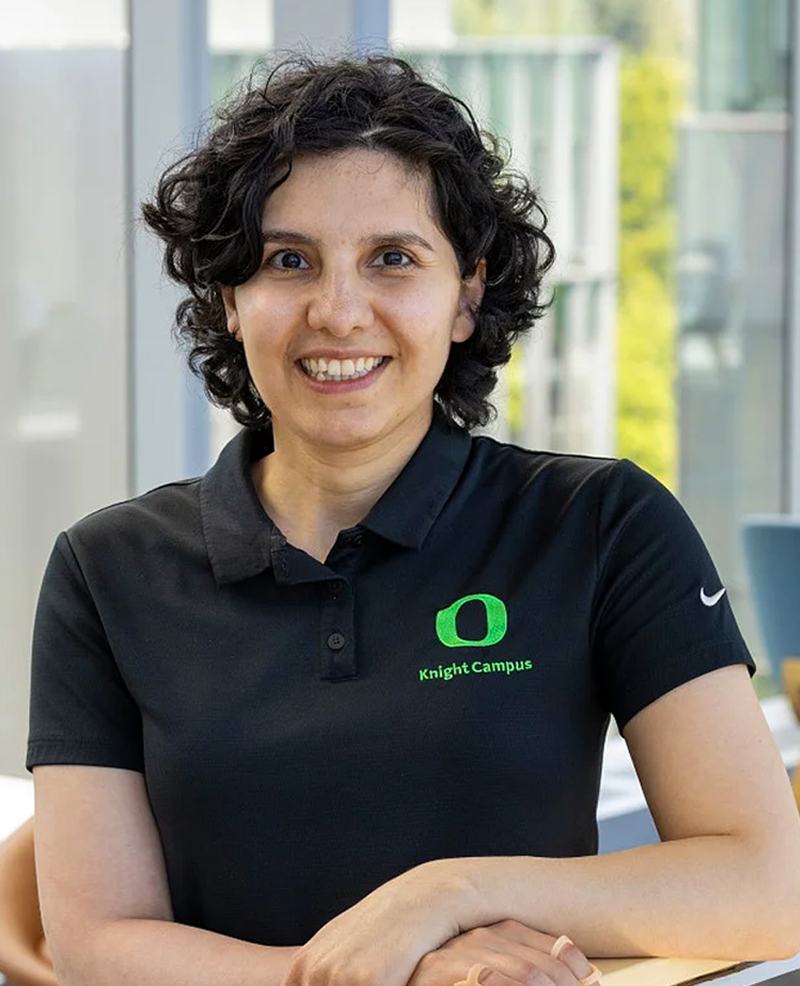
Assistant Professor, Department of Bioengineering, Knight Campus for Accelerating Scientific Impact
University of Oregon, United States
Parisa Hosseinzadeh designs peptides that nature never made. The question that organizes her work is whether a molecule's shape and its function can be specified in advance, on a computer, and then built so that it behaves as drawn. Macrocyclic peptides are an appealing place to ask it: large enough to bind a protein surface with something like the specificity of an antibody, small enough to be made by chemistry, and, when designed well, stable and able to reach targets inside the cell.
As a postdoctoral fellow in David Baker's laboratory she helped establish that such design is possible at scale. She was a lead author on a 2017 study that mapped the accessible landscape of ordered peptide macrocycles by near-exhaustive sampling of their backbones, designed more than two hundred of them, and confirmed by structure determination that the molecules folded into the shapes intended. The work moved macrocycle design from a case-by-case craft toward something closer to a catalog.
Her own laboratory at the University of Oregon has set out to make that process faster and more general, pairing physics-based modeling with machine learning and high-throughput experiments. A recent example is CyclicMPNN, a sequence-design network retrained specifically on cyclic backbones, which adapts a tool built for ordinary proteins to the particular geometry of a ring. The aim across these projects is a design pipeline that learns from its own data rather than starting fresh with each new target.
The purpose is functional peptides. Her group designs binders that inhibit a chosen protein, including some that exploit a target's disorder-to-order transition to pick out a single partner from a crowded interaction network, and it builds peptide biosensors and designed enzymes. A particular focus, and the subject of her NIH Director's New Innovator Award, is cell permeability: what lets a short peptide assembled from non-canonical building blocks cross a membrane, and how to design that property in rather than stumble on it.
Hosseinzadeh earned a BS in biotechnology from the University of Tehran and a PhD in biochemistry from the University of Illinois at Urbana-Champaign with Yi Lu, where she worked on the rational design of metalloproteins, engineering metal sites into proteins to tune their chemistry. She joined David Baker's Institute for Protein Design in 2016 and moved to the Knight Campus for Accelerating Scientific Impact at the University of Oregon as an Assistant Professor in 2020, with an affiliate appointment in Chemistry and Biochemistry.
Her work has been recognized with the NIH Director's New Innovator Award and, in 2026, the University of Oregon's Early-Career Award, its highest honor for early-career faculty. She comes to Boston representing a generation for whom peptide design is increasingly a computational discipline, and with the conviction that the molecules worth making are the ones you can specify before you build them.