
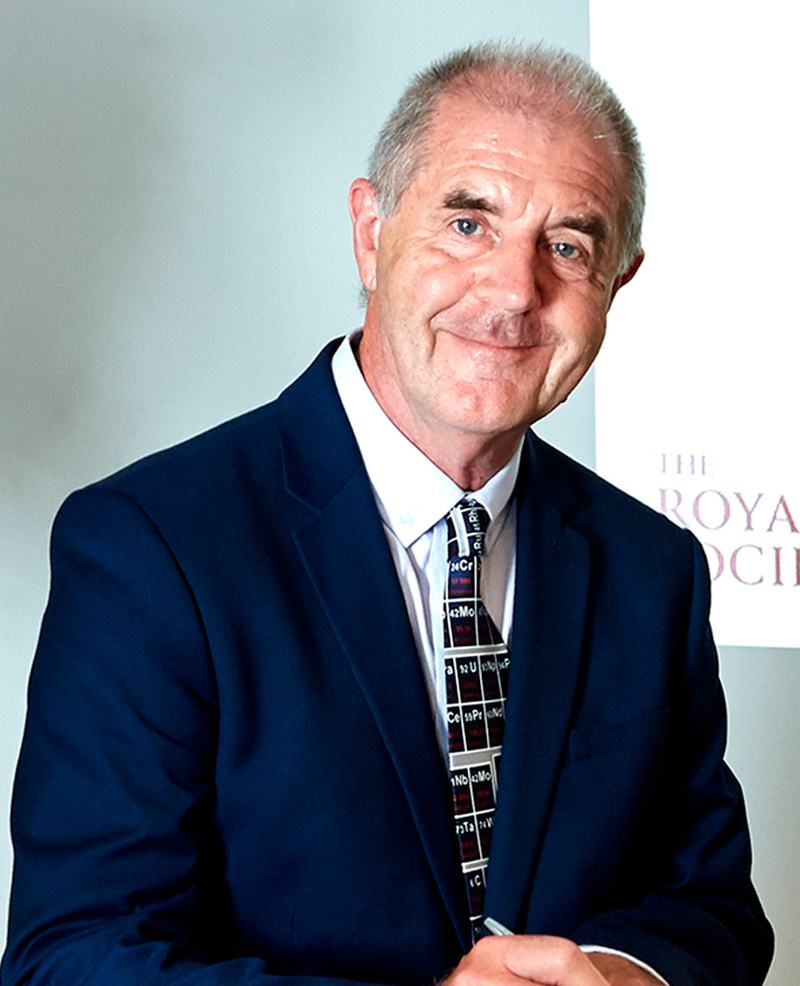
Professor
The University of Queensland, Australia
Professor, Institute for Molecular Bioscience, and Director, ARC Centre of Excellence for Innovations in Peptide and Protein Science
The University of Queensland, Australia
David Craik is Professor at the Institute for Molecular Bioscience, The University of Queensland, and Director of the Australian Research Council Centre of Excellence for Innovations in Peptide and Protein Science. His career has turned on a simple structural idea with large consequences: a peptide with no ends gives proteases very little to hold on to.
The idea came from a cup of tea. Women in parts of Africa boiled the plant Oldenlandia affinis and sipped the brew to accelerate labor, and the active component survived both the boiling and the gut. Craik's group determined its structure by NMR in the 1990s and found a head-to-tail cyclic backbone combined with a cystine knot, a topology without precedent in a gene-encoded protein. Kalata B1 became the founding member of the cyclotides, now the largest known family of circular proteins. As ribosomal cyclic peptides turned up elsewhere, his laboratory reported the first structures of the theta-defensins from animals and of the threaded lasso peptide microcin J25 from bacteria.
What began as structural biology became an engineering program. Cyclotides serve as ultra-stable scaffolds onto which bioactive epitopes are grafted, yielding leads for pain, cancer, and cardiovascular and metabolic disease. The same logic applies to venom peptides: backbone cyclization of the α-conotoxin Vc1.1 produced an orally active lead for neuropathic pain. More recently the group has helped establish how plants make these molecules, including the asparaginyl endopeptidases that close the ring, and has put that machinery to work as a route to growing peptide drugs in crop plants. Cyclotides have reached the field as well. Sero-X, a butterfly pea extract developed with Innovate Ag, was registered in 2017 as a bee-safe insecticide.
He received his Ph.D. in organic chemistry from La Trobe University in 1981, held postdoctoral positions at Florida State and Syracuse Universities, and joined the Victorian College of Pharmacy in 1983, becoming Professor of Medicinal Chemistry and Head of School in 1988. He moved to Queensland in 1995 to establish a biomolecular NMR laboratory. He is the author of more than 840 papers, has trained more than 70 Ph.D. students, founded the International Conference on Circular Proteins, and supports two community databases, CyBase and ConoServer.
He is a Fellow of the Royal Society and of the Australian Academy of Science and an Officer of the Order of Australia. His honors include the Ralph F. Hirschmann Award in Peptide Chemistry, 2011, the Josef Rudinger Memorial Lecture Award, 2012, and the David Craig Medal of the Australian Academy of Science, 2023.
He comes to Boston as the Society's 2015 Vincent du Vigneaud awardee and a former APS Councilor, with three decades of evidence that tying a peptide's ends together is one of the more useful things chemistry can do to it.